HK Math · Geometry
Quadrilaterals
Learn the definitions, properties, and proof conditions for special quadrilaterals, then connect them to the midpoint theorem and the intercept theorem.
Flow Of Ideas
Start with parallelograms. Rectangles and rhombuses are special parallelograms. A square is both a rectangle and a rhombus.
- Parallelogram: opposite sides are parallel.
- Rectangle: a parallelogram with four right angles.
- Rhombus: a parallelogram with four equal sides.
- Square: a quadrilateral with four equal sides and four right angles.
Parallelograms
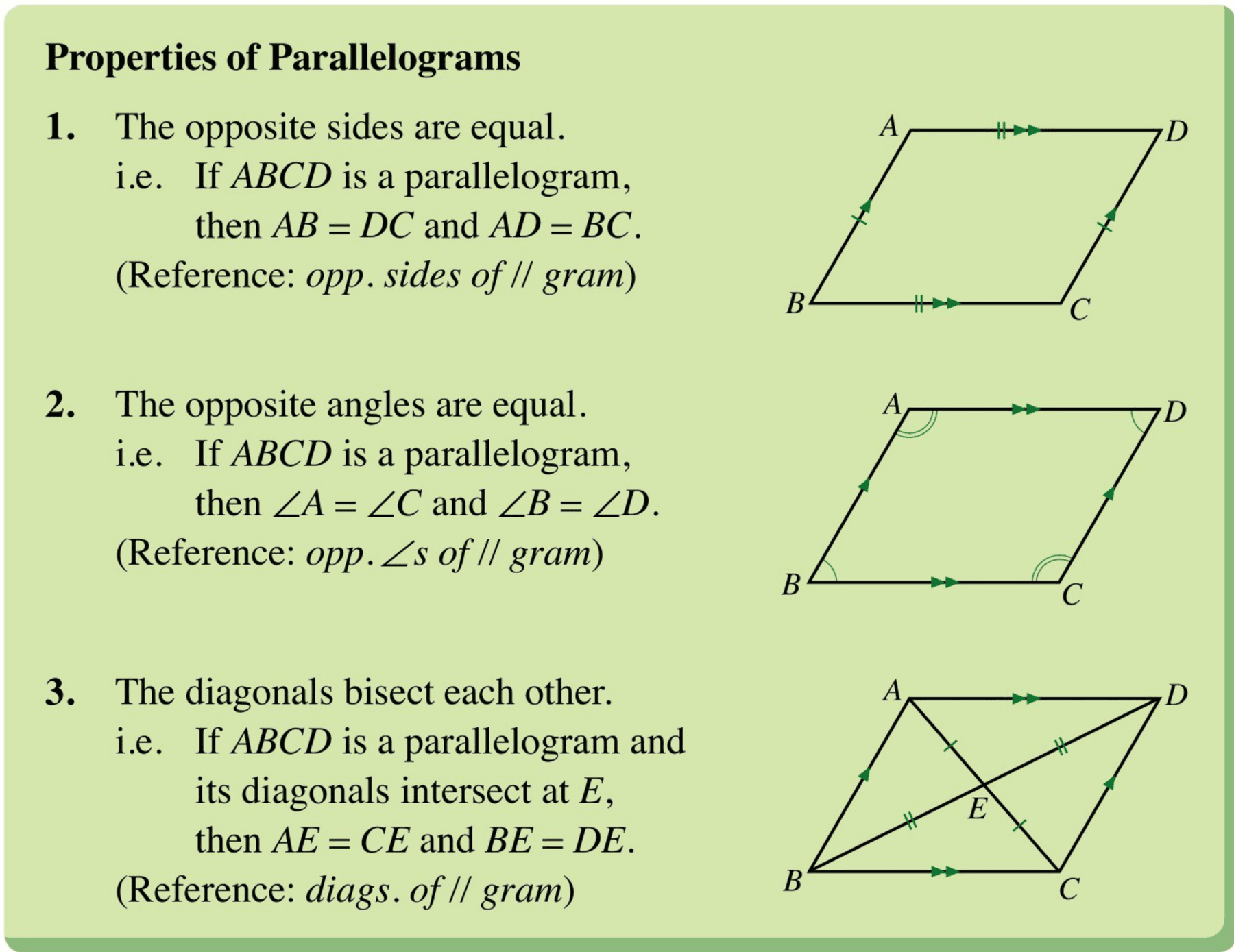
A parallelogram is a quadrilateral with two pairs of parallel opposite sides.
Properties
- Opposite sides are equal: AB = DC and AD = BC.
- Opposite angles are equal: angle A = angle C and angle B = angle D.
- Diagonals bisect each other: the intersection point divides each diagonal into two equal line segments.
Rectangles
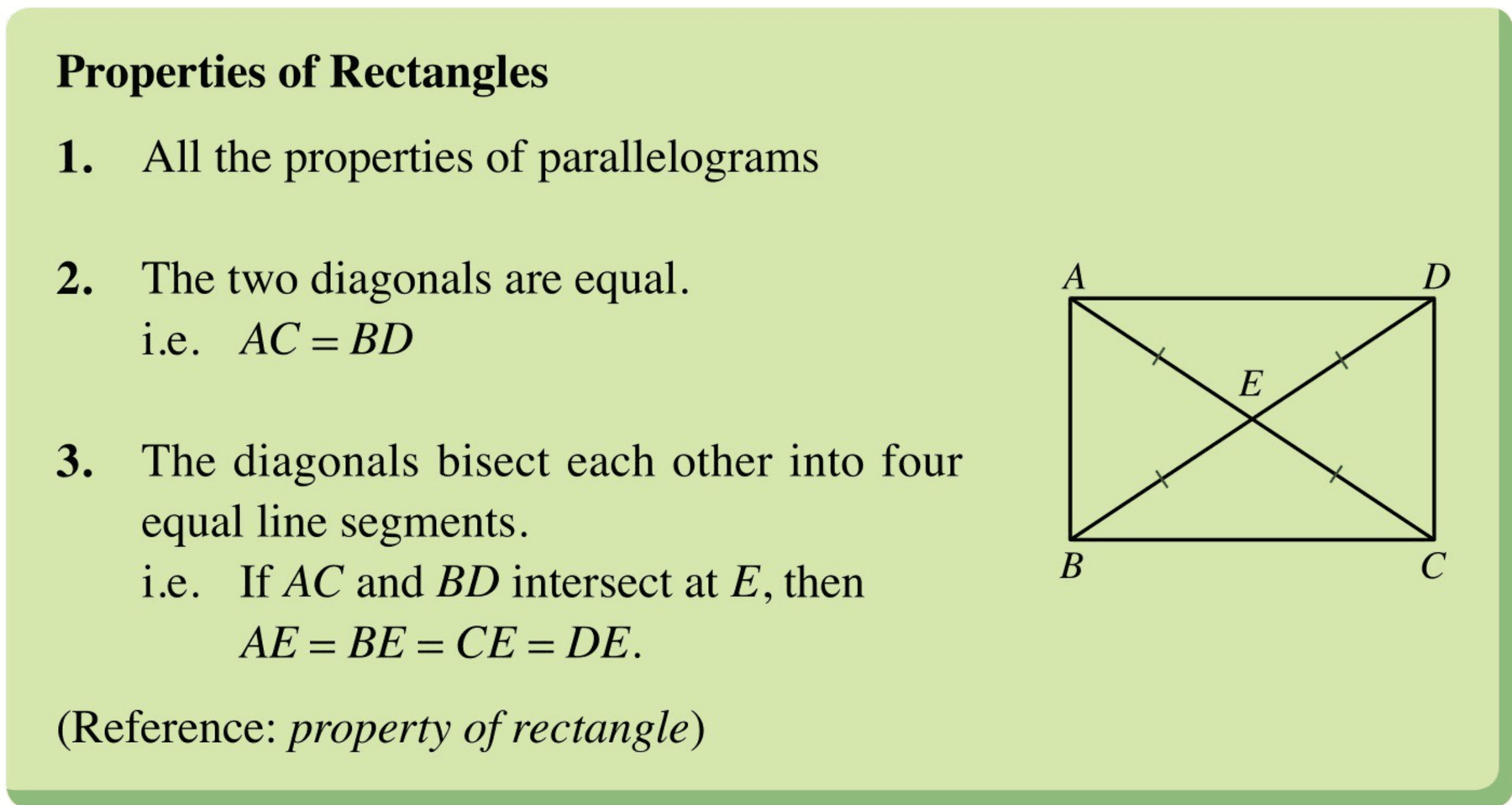
A rectangle is a quadrilateral with four right angles.
Properties
- Has all the properties of parallelograms.
- Diagonals are equal: AC = BD.
- The diagonals bisect each other into four equal line segments: AE = BE = CE = DE.
Rhombuses
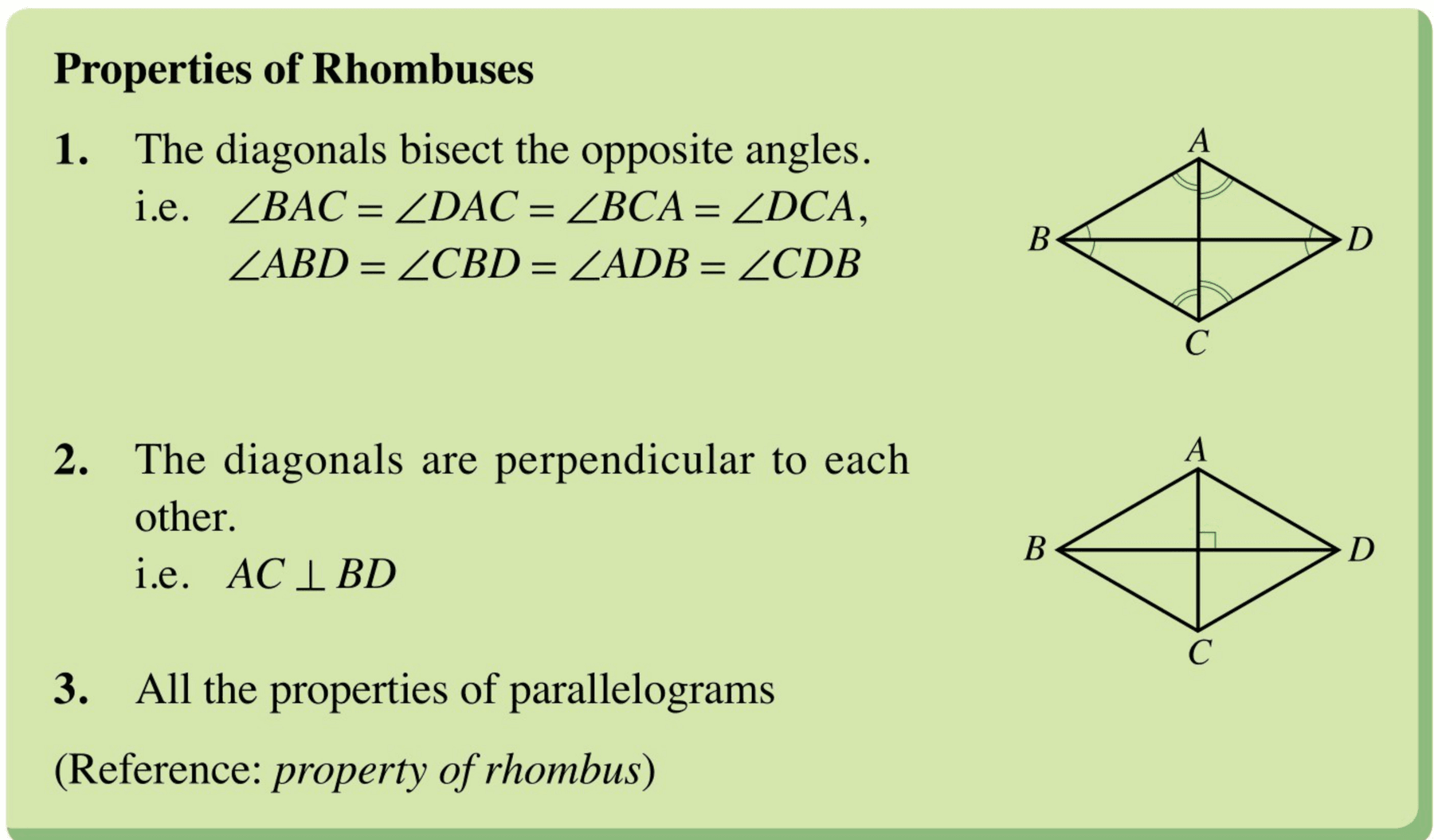
A rhombus is a quadrilateral with four equal sides.
Properties
- Has all the properties of parallelograms.
- Diagonals bisect the opposite angles, for example angle BAC = angle DAC.
- Diagonals are perpendicular to each other: AC is perpendicular to BD.
Squares
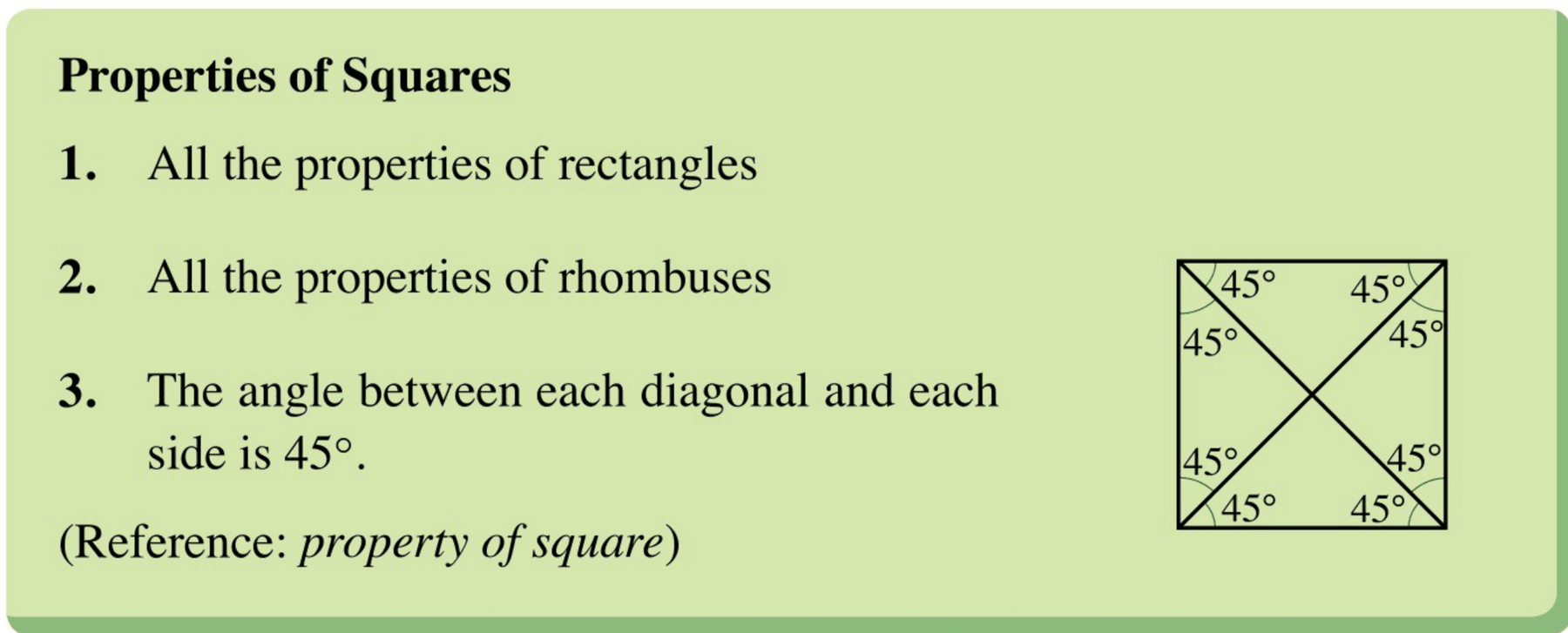
A square is a quadrilateral with four equal sides and four right angles.
Properties
- Has all the properties of rectangles.
- Has all the properties of rhombuses.
- The angle between each diagonal and each side is 45 degrees.
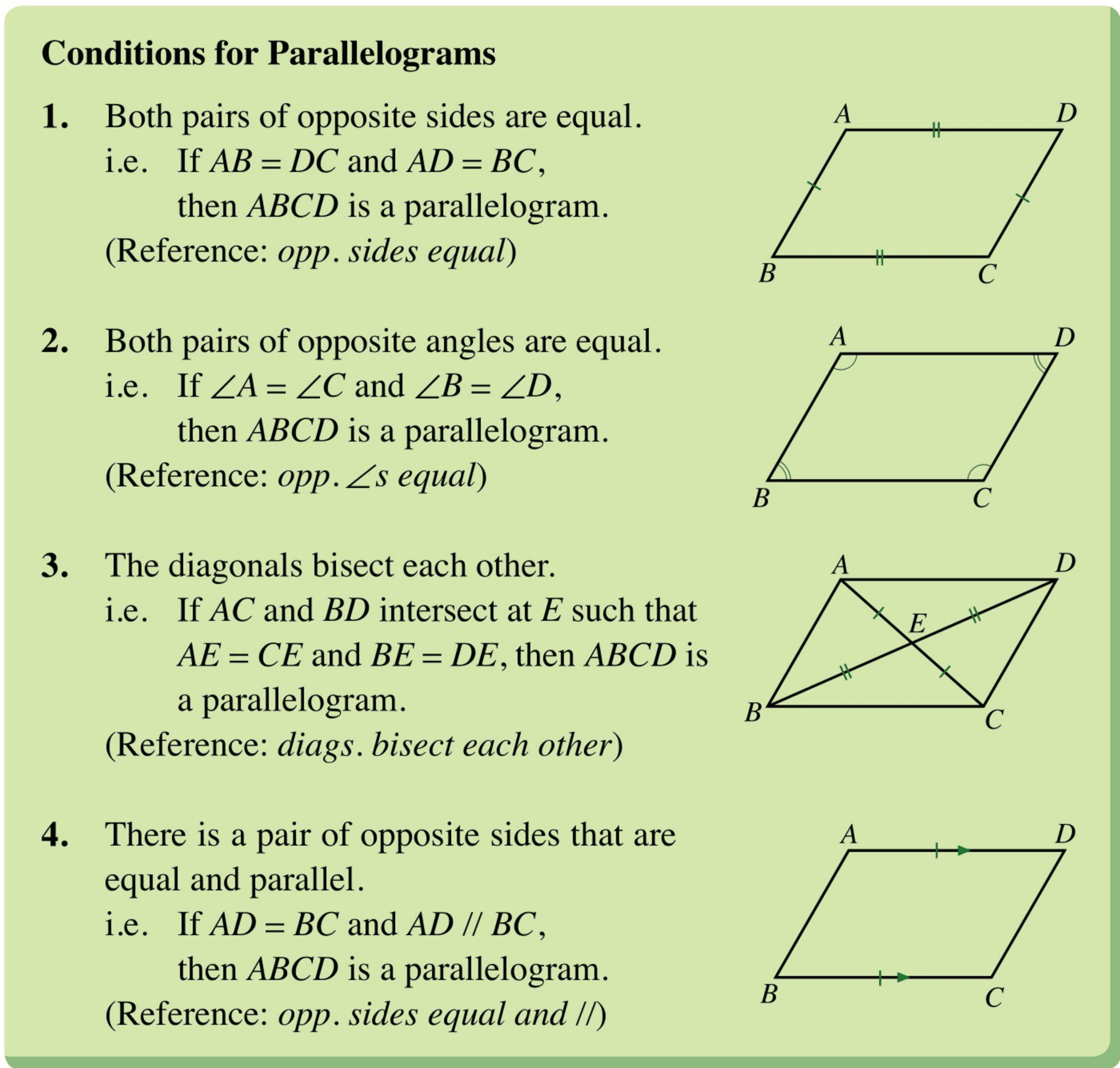
Conditions To Prove A Parallelogram
- Both pairs of opposite sides are equal.
- Both pairs of opposite angles are equal.
- The diagonals bisect each other.
- One pair of opposite sides is both equal and parallel.
Midpoint Theorem
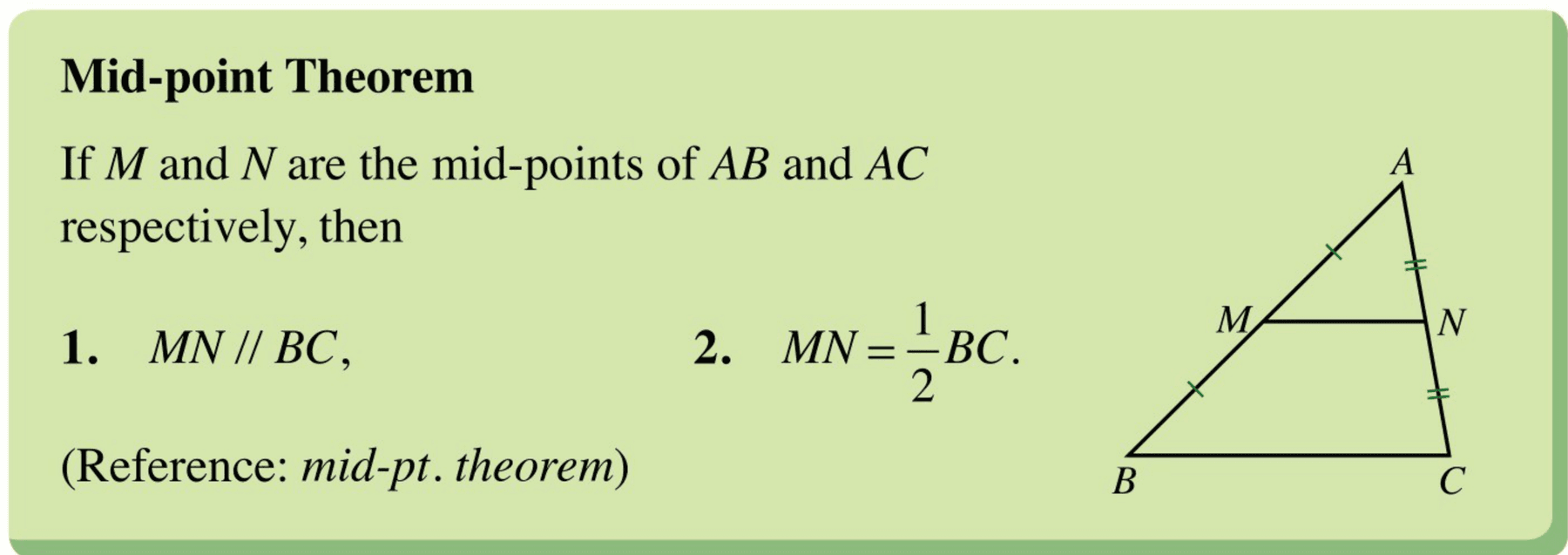
In triangle ABC, if M is the midpoint of AB and N is the midpoint of AC, then MN is parallel to BC and MN is half of BC.
- Given: AM = MB and AN = NC.
- Conclusion: MN is parallel to BC.
- Conclusion: MN = 1/2 BC.
- Use it to find unknown lengths or to prove two lines are parallel.
Intercept Theorem
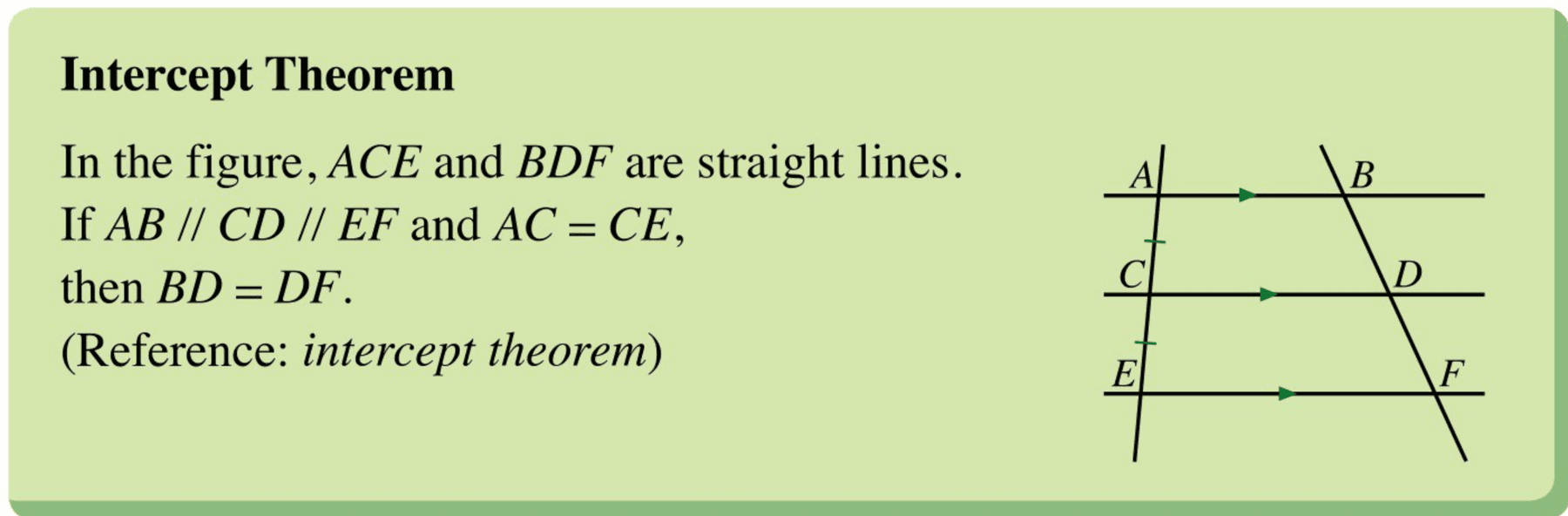
When parallel lines cut two transversals, equal intercepts on one transversal give equal corresponding intercepts on the other transversal.
- In the source figure, AB, CD, and EF are parallel.
- ACE and BDF are straight lines.
- If AC = CE, then BD = DF.
- Use it when several parallel lines cross two slanted lines.
Practice Checks
Check: Which Conditions Prove A Parallelogram?
- Both pairs of opposite sides are equal.
- Both pairs of opposite angles are equal.
- The diagonals bisect each other.
- One pair of opposite sides is both equal and parallel.
Check: How Are Rectangle, Rhombus, And Square Related?
- A rectangle is a parallelogram with four right angles.
- A rhombus is a parallelogram with four equal sides.
- A square has the properties of both rectangles and rhombuses.